ŁIB€RTA$, in Another Town
free entrance
Artist Mariana Pende and curator Darko Fritz will present the installation ŁIB€RTA$, an artwork that has, for almost two decades, explored the relationship between freedom, capital, and public space.
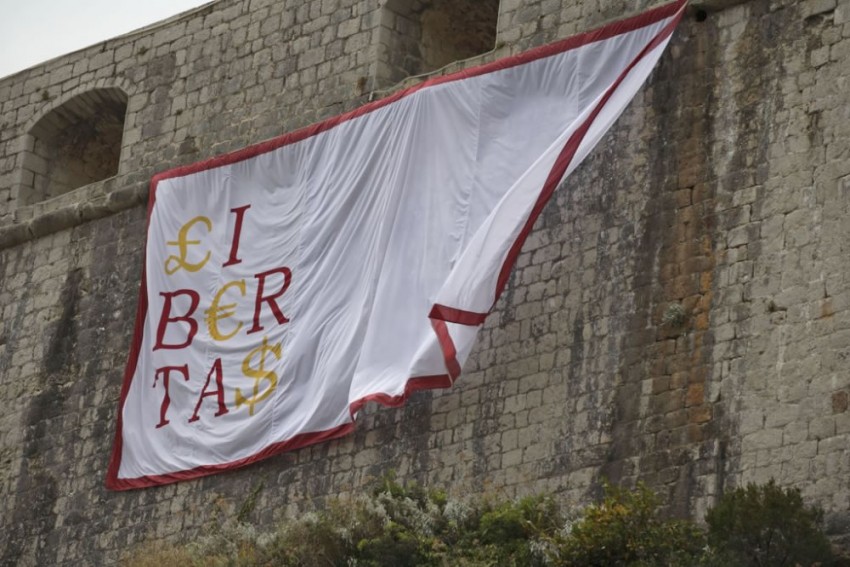
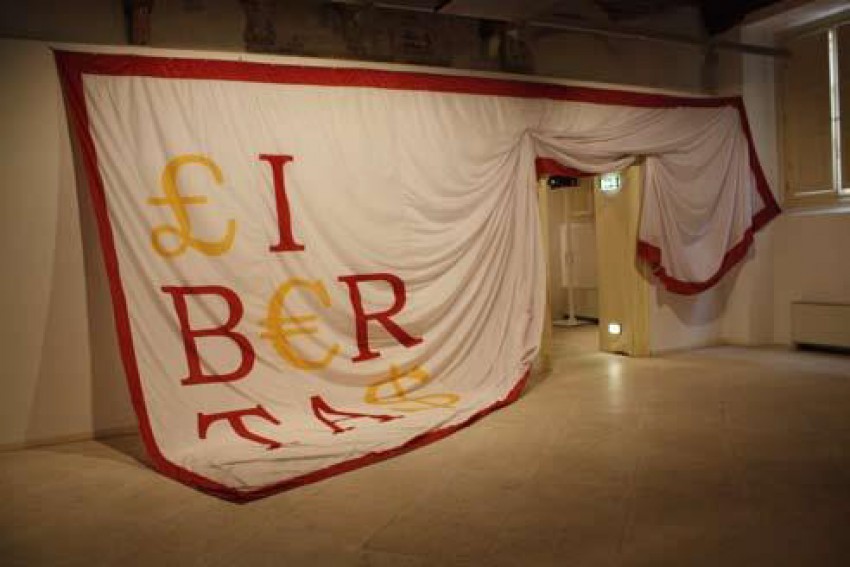
The central element of the project is a 5 × 10 metre silk flag that appropriates the visual identity of the Dubrovnik Summer Festival. Instead of the word Libertas, the flag bears the inscription ŁIB€RTA$, replacing individual letters with the symbols for the pound (£), the euro (€), and the dollar ($). The word "freedom," written through the symbols of global currencies, ironizes contemporary forms of economic and ideological dependency while questioning the meaning of freedom in an era dominated by market logic and the commercialization of public space.
In early February 2026, the project was proposed to the Korčula Town for a six-day installation on the southern exterior wall of the Great Governor's Tower, part of the town's medieval fortifications. Six months later, the Town authorities rejected the proposal, stating that the tower "is not an appropriate location for an installation of such dimensions, as it would disrupt the city's unique skyline," and that the work's identity was "associated with another city."
This decision raises broader questions about the position of contemporary art in public space and the possibilities of critical artistic practice that addresses overtourism, the relationship between local residents and visitors, and the personal, spatial, and economic freedoms of people living in cities whose economies have become increasingly dependent on tourism.
ŁIB€RTA$ was first installed in 2007 at Fort Lovrijenac during the Dubrovnik Summer Festival, entering into a direct dialogue with the motto of the Republic of Dubrovnik, Non bene pro toto libertas venditur auro ("Liberty is not sold for all the gold in the world"), carved above the entrance to the fortress. Building upon this historical symbol, the work examines the contemporary meaning of freedom in a society shaped by economic interests and market logic. Its presentation in Korčula further opens a dialogue about the island's relationship to Dubrovnik's experience and tourism-based models of development. In this context, the project forms part of Siva zona's programme strand Critical Tourism, which uses contemporary art to examine the aesthetic, social, spatial, and economic consequences of tourism-driven urban transformation.
Following its Dubrovnik presentation, the installation was exhibited in public space on the façade of the Meštrović Pavilion (HDLU) in Zagreb in 2008 as part of the exhibition ŁIB€RTA$ – Contemporary Dubrovnik Art. In 2010, it was presented in a gallery context as part of the international exhibition E-motion to Cohabit at the Galleria d'Arte Moderna Achille Forti in Verona.
Freedom has remained one of the central philosophical questions throughout history. In Dubrovnik, Libertas has for centuries been among the city's most enduring symbols and one of the defining values of the former Republic of Dubrovnik. Freedom occupied a central place in the Republic's political and cultural identity, celebrated by the poet Ivan Gundulić in Dubravka with the famous verses: "O beautiful, beloved, sweet freedom." The Libertas flag continues to be raised on Orlando's Column at the opening ceremony of the Dubrovnik Summer Festival.
The project also invites a reconsideration of both historical and contemporary understandings of freedom. While Venice, Korčula, and Dubrovnik were among the first European communities to restrict or prohibit the slave trade in different historical periods, today new forms of economic and spatial subjugation call for renewed critical reflection.(1) From household indebtedness and the exploitation of migrant labour to the privatization of public space and the wider consequences of uncontrolled tourism, the concept of freedom once again demands critical scrutiny.
Dubrovnik, Venice, and Korčula share a rich cultural heritage, but also the challenges of development based almost exclusively on tourism. Under such conditions, cultural heritage increasingly functions as an economic resource, while public space and the everyday lives of residents become adapted to the demands of the tourism market. At the same time, the absence of long-term cultural policies creates space for simplified interpretations of history and the spectacularization of heritage—a process frequently described in cultural tourism theory as Disneyfication.
Darko Fritz
(1) Early legal sources indicate that several European communities restricted or prohibited the slave trade as early as the Middle Ages. In 960, Doge Pietro IV Candiano prohibited the trade in Christian slaves in the Republic of Venice. The Icelandic law code Grágás (12th century, based on earlier customary law) contains provisions reflecting the gradual abolition of slavery in Iceland. The Statute of the Town of Korčula (1214) includes provisions prohibiting the slave trade, while in 1416 the Major Council of the Republic of Dubrovnik adopted a formal ban on slave trading, regarded as one of the earliest such legal acts in Europe.
About author
Mariana Pende is an artist whose practice spans sculpture, installation, sound, and video, exploring the economic, social, political, and environmental conditions of contemporary society. Through her work, she develops original materials and site-specific interventions, investigating the relationship between materiality, architecture, and public space. She graduated from the Accademia di Belle Arti in Venice in 2008, where she participated in the Atelier Aperti programme of the 51st Venice Biennale (2005). In 2019, she took part in the exhibition Point of Interrupted Departures as part of the 58th Venice Biennale (Dubrovnik Pavilion). In 2023, she presented the site-specific installation Dance De Luxe at the Bačva Gallery (HDLU), Zagreb, alongside Olaf Nicolai. In 2025, she participated in the artist residency and exhibition Common Threads at Kunsthaus Dahlem in Berlin; the project was subsequently presented as part of BienalSur 2025 in collaboration with the Museum of Contemporary Art Oaxaca (Mexico). Her solo exhibitions have been presented at the Museum of Modern and Contemporary Art in Rijeka, the Museum of Contemporary Art of Istria in Pula, and the Glyptotheque of the Croatian Academy of Sciences and Arts (HAZU) in Zagreb. She has participated in numerous international group exhibitions throughout Europe and the United States, and her works are held in public and private collections. She lives and works in Zagreb.