Death in Korkyra (3/4)
Free entrance
Exhibition at four venues:
15–27 May 2026 – Centre for Culture Korčula
7 July – 20 September 2026 – Museum of Contemporary Art Zagreb
17 July – 19 August 2026 – Korčula Town Museum
17 July – 6 September – Wi-Fi Gallery grey) (area
On the occasion of the 20th anniversary of the death of the artist Željko Jerman (Zagreb, 10 March 1949 – Korčula, 17 July 2006) and the 20th anniversary of Gray Area (Siva zona), which inaugurated its gallery programme on 24 July 2006, this exhibition project marks two important continuities simultaneously: Jerman’s artistic legacy and two decades of a platform dedicated to contemporary art.
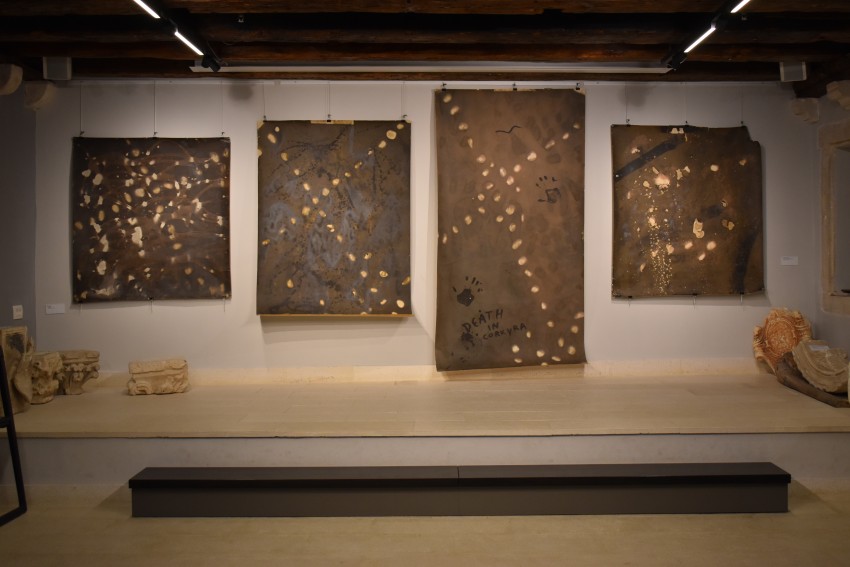
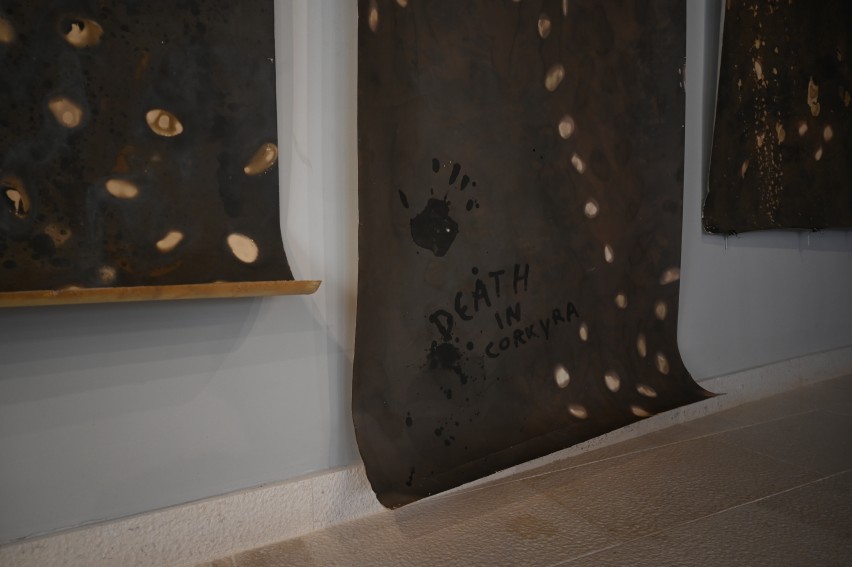
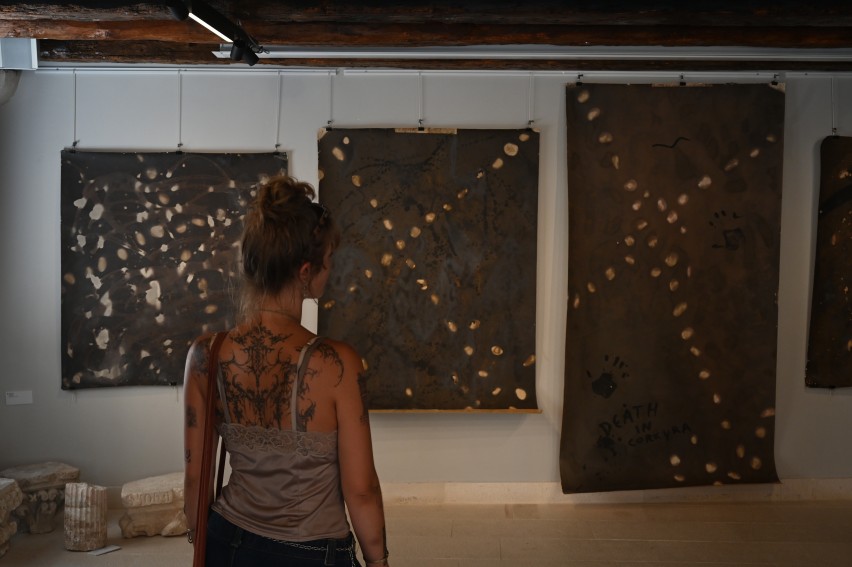
The exhibition at the Korčula Town Museum brings together four works created in Korčula in 1995 (Work 4, Work 7, Work 8, and Work 11), executed on large-format photographic paper using the photogram technique with interventions in photographic chemicals. On the surface of Work 7, Death in Corcyra, the artist leaves the imprints of both palms, evoking the earliest known human images—the handprints found in prehistoric caves. Here, the trace of the body emerges as one of the fundamental motifs of Jerman’s oeuvre, now intertwined with the transience of the photographic material itself. Rather than using the spelling Korkyra, Jerman writes Corcyra. Whether this reflects a deliberate Latinisation or simply a variant of the name cannot be determined with certainty. Although Korčula was part of the Venetian Republic for centuries, sharing with Venice its patron saint, St Mark, it is possible that the title also alludes to Thomas Mann’s Death in Venice and its film adaptation. There is, however, no direct evidence to support such an interpretation. Death in Corcyra encapsulates Jerman’s central artistic proposition: everything that comes into being simultaneously begins to disappear. Photography, the body, and memory are all subject to the same process. The artwork does not exist despite transience, but precisely because of it. The trace endures only because it is ephemeral.
The exhibition cycle, presented at three venues in Korčula and at the Museum of Contemporary Art in Zagreb, is organised through a collaboration between the Museum and Gray Area, a space for contemporary and media art, and runs from 15 May to 20 September 2026. Curated by Darko Fritz and Radmila Iva Janković, the exhibitions bring together Jerman’s works from the collection of the Museum of Contemporary Art in Zagreb, works from the Bojana Švertasek Collection, as well as extensive archival material and photographic documentation. The exhibition concept takes Death in Corcyra as its point of departure, with the title symbolically referring to Jerman’s artistic and existential connection with the island of Korčula. It was there that he realised a series of projects and exhibitions—from the mosaic in Potirna (1981), now permanently installed in Vela Luka, to the solo exhibitions Korčula, My Working City (ACI Marina, Korčula, and the Vela Luka Cultural Centre, 1995) and Time Works in the Tavern (Vela Luka Cultural Centre, 2003).
An important place within this sequence is occupied by the exhibition Korkyra on My Mind, held in 1994 at Gallery PM of the Croatian Association of Artists (HDLU) in Zagreb. That exhibition further consolidated the relationship between the island as a site and Jerman’s conceptual exploration of photography, text, and personal narrative.
This multi-venue project reaffirms Jerman’s position as one of the key figures of the Croatian conceptual art scene, highlighting the distinctive relationship between artistic practice, place, and memory, while also demonstrating the continuity of collaboration between museum institutions and the independent cultural sector in presenting and reinterpreting museum collections.
About author
Željko Jerman (Zagreb, 10 March 1949 – Korčula, 17 July 2006) was a Croatian contemporary artist and essayist, and one of the key protagonists of conceptual art in Croatia during the 1970s. After discontinuing his formal education in 1967, he devoted himself to photography, completed a photography course, and passed the exams required to run an independent studio. In 1970, he opened the photographic atelier Blow Up in Zagreb, and from 1972 to 1974 he studied photography by correspondence (FPS – Famous Photography School).
From the early 1970s onward, he radically reexamined the medium of photography, focusing on its technical and chemical properties. Rejecting the conventions of aesthetically “successful” photography, he deliberately produced blurred and “bad,” materially emphasized works, intervening directly in photographic paper with developer, scratching, tearing, and burning. In 1974, he initiated the cycle of elementary photography, reduced to the direct application of photochemicals onto paper without the use of a camera (Krepaj fotografijo!, 1974). His works from this period are strongly marked by processuality and existential intensity.
From 1975, he was active within the Group of Six Authors, with whom he carried out actions and exhibitions in public spaces. In the work My Year (1977), he encapsulated his artistic and personal positions of that time. In the late 1970s and throughout the 1980s, he developed multimedia approaches, incorporated text into his works, and intensively produced cycles of photo-paintings, which remained a constant in his oeuvre until the end of his life.
He was also active as a writer and critic, publishing in Polet, Studentski list, Danas, Studio, Oko, Jutarnji list, and Zarez. In 2006, his book Lost Portraits (Zagubljeni portreti) was published, and he continued writing his column Egotrip until the final days of his life.