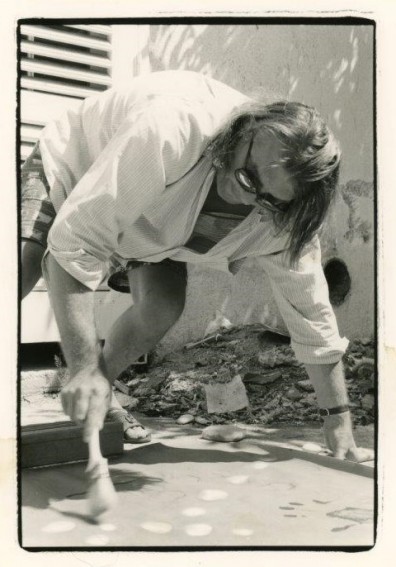
Death in Korkyra (2/4 - from the collection of the Museum of Contemporary Art Zagreb)
15–27 May 2026 – Centre for Culture Korčula
7 July – 20 September 2026 – Museum of Contemporary Art Zagreb
17 July – 19 August 2026 – Korčula Town Museum
17 July – 6 September – Wi-Fi Gallery grey) (area
On the occasion of the twentieth anniversary of the death of Željko Jerman (Zagreb, 1949 – Korčula, 2006), the Museum of Contemporary Art, in collaboration with Gray Area (Siva zona), the contemporary and media art space in Korčula, presents an exhibition forming part of a broader programme taking place in both Korčula and Zagreb. In doing so, it establishes a symbolic dialogue between the city where the artist was born and the city he referred to as his “working city,” where he died prematurely.
The exhibition at the Museum of Contemporary Art also recalls Jerman’s early connection with the institution, which recognised the significance of his work from the very beginning of his artistic career. The selection of works from the museum’s collection spans the period from his earliest Subjective Photographs, a series first presented in 1975 at the then Gallery of Contemporary Art as part of the Centre for Photography, Film and Television (CEFFT) programme, to works from the 1990s, including pieces created in Korčula.
Although Jerman was one of the most radical investigators of the photographic medium in Croatian art, his practice was never confined to questions of the medium itself. At a time when artists associated with the analytical current of conceptual art were rationally examining the conditions of image-making and reducing the medium to its fundamental components, Jerman applied similar premises to photography while developing a distinctly different approach. Rejecting the camera and reducing photography to light, trace, chemical process, and the materiality of photographic paper, he transformed these elements into a means of inseparably intertwining art and life.
Twenty years after the artist’s death, this dialogue between Zagreb and Korčula pays tribute to an artist who transformed the traces of his own existence into one of the most compelling chapters of Croatian contemporary art.
https://www.msu.hr/dogadanja/zeljko-jerman-death-in-korkyra-iz-zbirke-msu-a/1969.html
About author
Željko Jerman (Zagreb, 10 March 1949 – Korčula, 17 July 2006) was a Croatian contemporary artist and essayist, and one of the key protagonists of conceptual art in Croatia during the 1970s. After discontinuing his formal education in 1967, he devoted himself to photography, completed a photography course, and passed the exams required to run an independent studio. In 1970, he opened the photographic atelier Blow Up in Zagreb, and from 1972 to 1974 he studied photography by correspondence (FPS – Famous Photography School).
From the early 1970s onward, he radically reexamined the medium of photography, focusing on its technical and chemical properties. Rejecting the conventions of aesthetically “successful” photography, he deliberately produced blurred and “bad,” materially emphasized works, intervening directly in photographic paper with developer, scratching, tearing, and burning. In 1974, he initiated the cycle of elementary photography, reduced to the direct application of photochemicals onto paper without the use of a camera (Krepaj fotografijo!, 1974). His works from this period are strongly marked by processuality and existential intensity.
From 1975, he was active within the Group of Six Authors, with whom he carried out actions and exhibitions in public spaces. In the work My Year (1977), he encapsulated his artistic and personal positions of that time. In the late 1970s and throughout the 1980s, he developed multimedia approaches, incorporated text into his works, and intensively produced cycles of photo-paintings, which remained a constant in his oeuvre until the end of his life.
He was also active as a writer and critic, publishing in Polet, Studentski list, Danas, Studio, Oko, Jutarnji list, and Zarez. In 2006, his book Lost Portraits (Zagubljeni portreti) was published, and he continued writing his column Egotrip until the final days of his life.