Imaginary Futures: Tourism (exhibition Korčula)
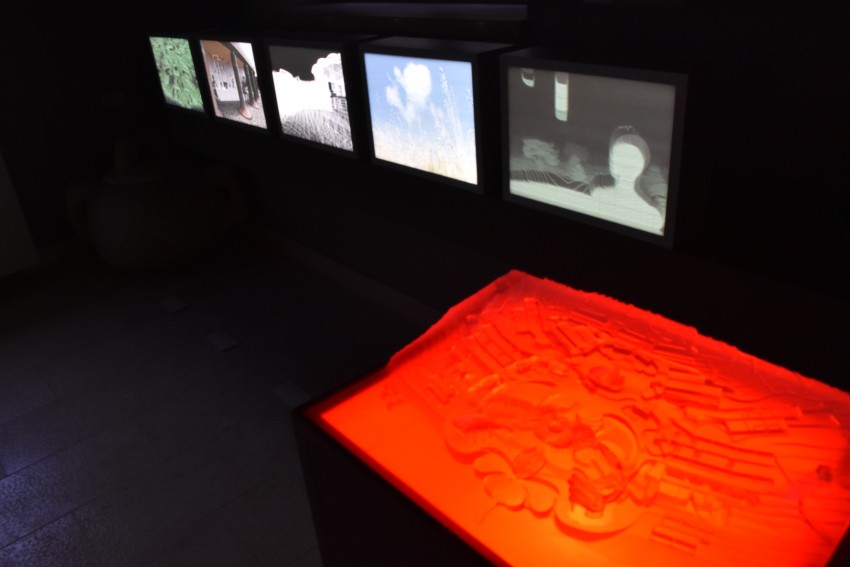
The central motif of the project “Imagined Futures (Tourism)” is an undeveloped tourist settlement, conceived at the 2nd International Artists’ Meeting in Vela Luka in 1970 for the location of the nearby Plitvine bay. The general plan by Cuban architect Ricardo Porro of the settlement in the form of the human body was elaborated by thirty international urban planners, theoreticians, architects, and artists.
The administration was planned in the position of the head, the restaurant in the stomach, the park/labyrinth in the intestines, and the communication with the sea in the position of the genitals. The settlement was conceived as a kind of gesamtkunstwerk synthetising architecture, sculpture, painting and tourism in a new and liberated social atmosphere.
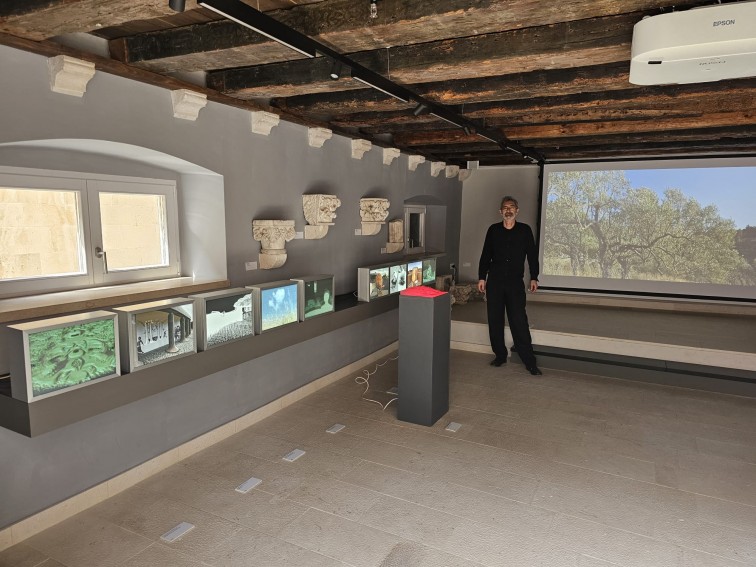
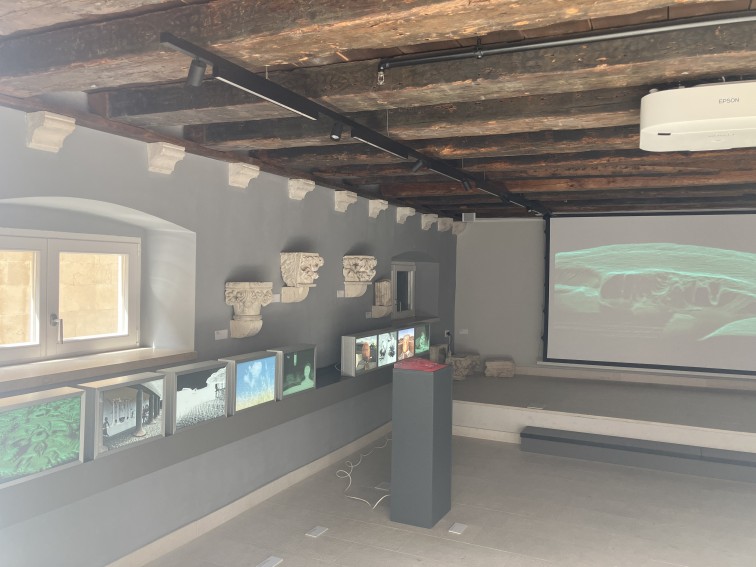
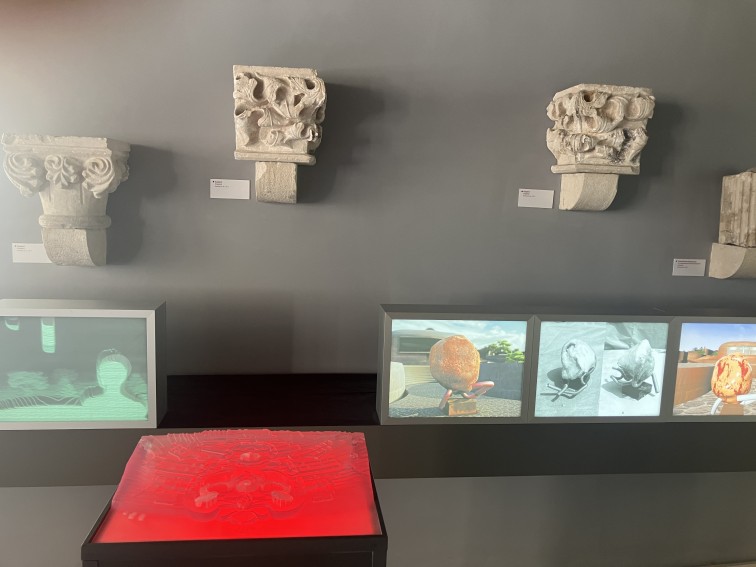
Through film, VR installation, prints and sculptures, the project revived the unrealised utopian ides intertwined with the documentation of architectural visions and artworks conceived for the tourist settlement: the heart sculpture by Alina Szapocznikow, the land-art intervention by Ugo La Pietra on the nearby islet of Ošjak, the mosaic by an anonymous author, the functional sculpture “Slides” by Pierre-Martin Jacot, and the “musician’s house” by painter Claude Bellegarde in the form of a stylised penis. The project examines the concept of potential tourism and its orientations through visionary architecture, the legacy of modernism of the 1970s, thereby establishing relations between projections of the future and the latter’s achievements, and present-day’s social awareness of spatial conception and planning.
The film “Imagined Futures (Tourism)” introduces us to a Mediterranean landscape while the model of the utopian settlement represents the visual base of the film bordering between the analogue and the digital world. The film also features the video archive of the 1st International Artists’ Meeting in Vela Luka in 1968, which saw a plethora of mosaics, as well as the audio archive voiced by Ricardo Porro, who talks in French about the project that was still in the making at the time, and decades later in English about the same project, when he noted it as one of his undeveloped projects. By using the oscilloscope in image processing, the film represents a new set of artefacts and visual appearances, made possible in collaboration with Ivan Marušić Klif.
The polyptych “Heart (for Alina)” is dedicated to the Polish artist Alina Szapocznikow (1926–1973), whose two documentary photographs are models of the sculpture for the tourist settlement included in the work itself. These hitherto unpublished photographs were found during years-long research in the private archive of Petar Omčikus (1926–2019) and his wife Kosa Bokšan (1925–2009).
The author of the project is Darko Fritz, the collaborator on making the architectural model is Tomislav Tabain, Dimitri Medvedev authored the 3D rendering, Ivan Marušić Klif is behind the oscilloscope image processing, while the author of the VR environment is Vedran Gligo. The film has been coproduced by the Creative Syndicate with Grey Area (edited by Hrvoslava Brkić, music by Francisco Lopez, cinematography by Boris Poljak).
The VR work and research have been produced by the grey) (area association, as part of the project line History of Contemporaneity: International Artists' Meetings in Vela Luka (1968-1972 which provides an insight into the private and public archives in Croatia, France, Italy, Poland, and Serbia.
Utopia, Dystopia, or Something in Between?
Sani Sardelić
Imagined Futures: Tourism is the artistic result of a years-long project through the deliberation on possible future worlds, and a scientific research and creation of conceptual art solutions authored by Darko Fritz. It is based on the architectural-urbanistic concept design and model of a tourist settlement in the form of a human body by the Cuban architect Ricardo Porro (1925–2014), made in 1970 during the biennial event International Artists’ Meetings in Vela Luka. The elaboration of the project itself also featured other artists, active participants of the International Meetings in Vela Luka, which Fritz especially highlighted in his work. Fritz’s work was presented previously in February 2024 in Zagreb (Kranjčar Gallery) and in March 2024 in Split (Galić Salon).
In accordance with his hitherto curatorial and artistic preoccupations, Darko Fritz toys – in a recycling manner, so to speak – with the unactualized architectural-urbanistic work of Ricardo Porro through an illuminative citation dialogue, which foresaw as its physical location in real life, just like a utopia, one of the natural, then still virginal and untouched by tourism, bays of the island of Korčula – Plitvine near Vela Luka. The cited author himself, Porro, relied on an artistic predecessor; the Italian Mannerist painter Giuseppe Arcimboldo, the student of Leonardo da Vinci himself. Arcimboldo’s phantasm and effect of bizarreness did not particularly fit in his contemporaries’ conventional expectations; to them, he was fleetingly amusing and soon forgotten, and it seems that his marvellous world was over-the-top, even for the Mannerist period. However, he was rediscovered by the representatives of Surrealism and Dadaism in the early 20th century. The array of authors to whom this unique phantasmagorical world of Arcimboldo’s presented a challenge was also joined in the early 1970s by architect Ricardo Porro. Seeking to synthetise visual arts and relate it to organic, primarily anthropomorphic forms as one of the determinants of contemporary art, Porro conceived a tourist settlement in the form of a human body, with a specific role for individual body organs. Hence, for example, the reception and administrative units are located within the head, the restaurant is at the centre in accordance with the position and role of the stomach in the human body, while the rooms and spaces of night rest are set in the area of the extremities. The communication with the sea, placed in the position of the genitals, is especially impressive. This quite specifically designed architectural concept is not devoid of humour, even from the catalogue, i.e., peculiar impression left on us by the obese, stout human body with unmistakably male sexual characteristics lying on the beach. Through metaphoric glasses, we read the tourism of the sun and the sea in full zenith.
The hyperrealist element of Fritz’s work Imagined Futures: Tourism is the piece Heart for Alina. With this segment, physical comedy is abolished in an especially poignant manner, which makes us painfully face the unhealed wounds of living participants of the Second World War, especially the holocaust. The central object, Heart for Alina, is an unactualized sculpture of the heart by Alina Szapocznikow (1926–1973), which Fritz visualises with special attention. Building on the first impression of comedy and estrangement of Porro’s work, the encounter with Alina’s heart reminds us of the subtitle of Critchley’s book On Humour: “Our Souls, Arseholes” (2002:51).
The film and the VR installation, as well as film clips and other visual materials placed in lightboxes, open up our view of futuristic sights, which provoke different emotions: amazement, discomfort, even terror, and hence the problem of dystopia. Tourism is imposed on us today, and is also frequently accepted as the only substrate of progress. In spaces perceived as desirable tourist destinations, time changes our space and us in it faster than ever before. We are ready to subject to tourism our everyday life rhythms and change our priorities in the long term. With today’s time lapse since Porro’s architectural-urbanistic concept design, and with the experience of numerous pieces of Slumbering Concrete on the east Adriatic coast, Imagined Futures: Tourism are not merely visions, but often a painful and inconceivable reality materialised in our own, human disregard for the most important resource – space. It seems that Darko Fritz’s work warns us of this very fact.
Translation: Mirta Jurij
About author
Darko Fritz (1966) is a visual artist and freelance curator. He has presented his work at more than thirty solo and over a hundred group exhibitions worldwide, and was also active in the artistic groups The Imitation of Life Studio (Studio Imitacija Života, with Željko Serdarević, 1987–1990) and Cathedraal (Katedrala, 1988). He critically observes the society-changing technology, while his work bridges the gap between contemporary art, media art and network culture, thereby taking over topics such as glitch and monitoring. Alongside works in different media (print, photography, film, video, VR, internet, etc.), he has also executed a series of installations in public space, using untypical media – such as tram traffic control or horticultural installations – and combining contents from the digital domain with organic materials.
In 2006, he initiated the association siva) (zona [grey) (area], as part of which he has curated more than 50 exhibitions. The list of over a hundred exhibitions he has hitherto curated includes I Am “Still Alive” (digital art of the 1960s and the 1970s, and the recent low-tech and internet art), Zagreb, 2000; “CLUB.NL – Contemporary Art and Art Networks from the Netherlands,” Dubrovnik, 2000; “bit international – [New] Tendencies – Computers and Visual Research, 1961–1973,” Neue Galerie, Graz, 2007, and ZKM, Karlsruhe, 2008–2009; “Reconstructions: Private=Public= Private=Public=,” Belgrade, 2009; “Angles and Intersections” (co-curated with Nina Czegledy, Elena Rossi and Peter Dobrila, art director: Christiane Paul), MMSU, Rijeka, 2009; and “Histories of Post-Digital,” Akbank Sanat, Istanbul, 2014.
He authored the book “Digital Art in Croatia (1968 –1984),” Technical Museum Nikola Tesla, Zagreb, 2021, and the eponymous exhibition in 2022, as well as the thematic segment “Media Art” featuring the text “A Brief Overview of Media Art in Croatia (since the 1960s)” and the relevant database for culturenet.hr, 2002. He co-edited (with M. Gattin, M. Rosen, and P. Weibel) the book “A Little-Known Story About a Movement, a Magazine, and the Computer’s Arrival in Art: New Tendencies and Bit International, 1961–1973,” ZKM, Karlsruhe / MIT Press, Cambridge, Mass., 2011. He is a member of the professional organisations AICA, HDLU and HZSU, and an honorary member of ULUPUH.
http://darkofritz.net