Fishing
“Small scale fishery is a category of fishing for personal needs which was abolished completely on December 31, 2014, based on the contract on Croatia entering the European Union" (National Newspaper, International Contracts – No. 2/12, Law on the Sea Fishery, NN 62/17, 130/17, 14/19, in force since Fenruary 15, 2019, Article 3/4).
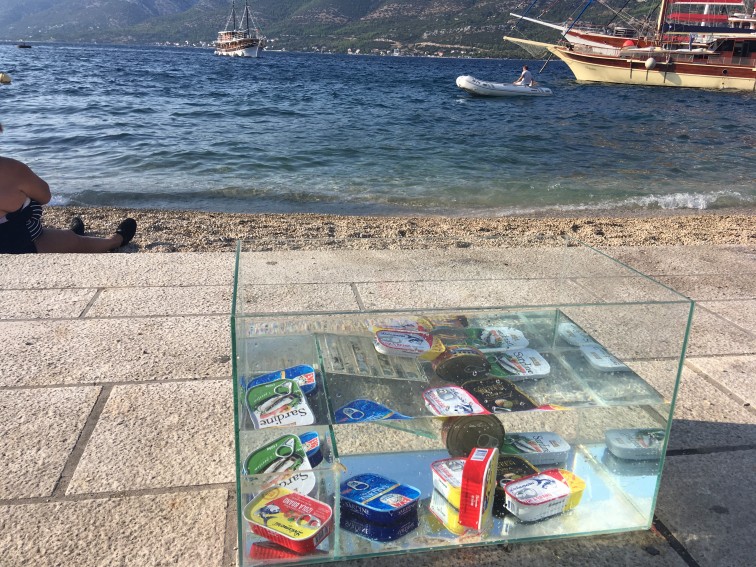
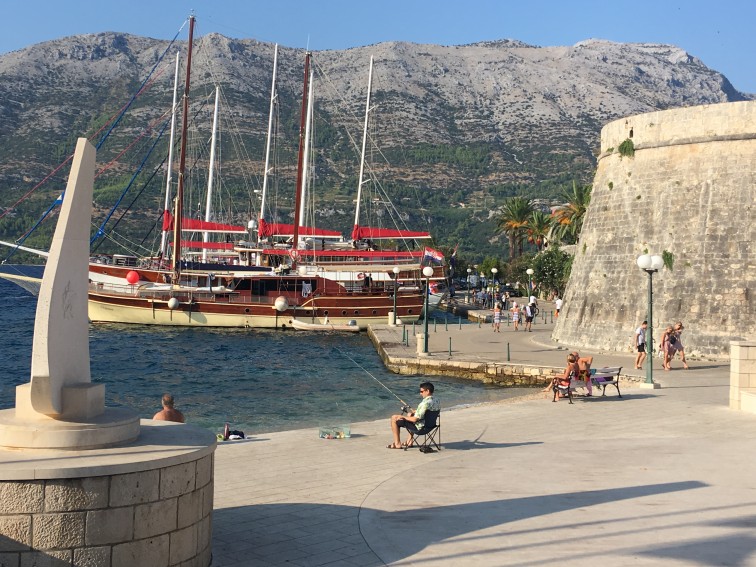
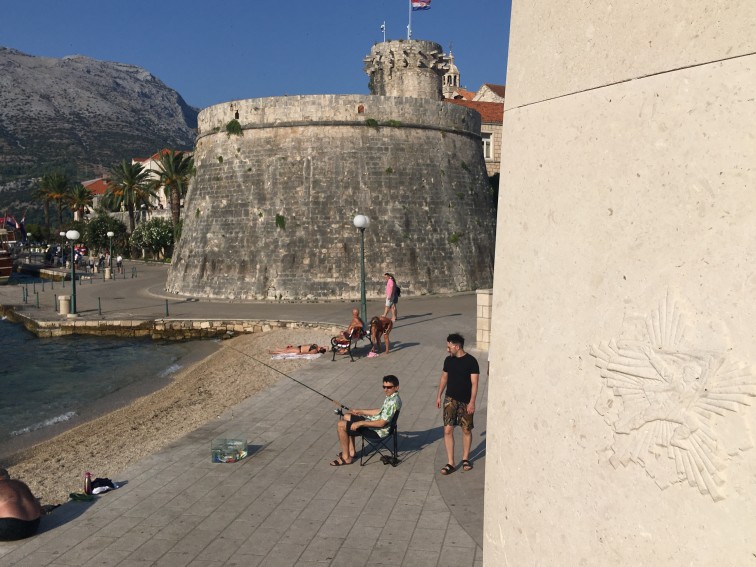
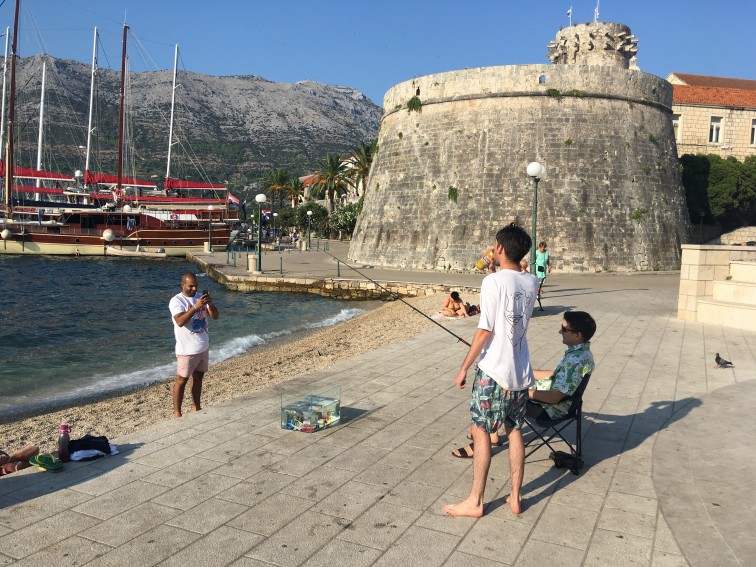
Art performance "Fishing" from 2018 was described by its author Siniša Labrović in the following words: "I am sitting on the chair and am trying to fish in an aquarium filled with the sea water. What I am fishing are the fish in cans. Performance durates for some hours, according to circumstances and the given context. In Ljubljana it durated for seven hours. It is important for me that this duration emphasizes the absurdity, but also the persistence that goes against the possibility of hopelessness. Everything seems already done and solved, simultaneously “certain”, but the in spite of that performance insists on pushing the limits, surpass the impossible. Performance hopes for miracle." (1)
So far the performance has been carried out on the locations in Slovenia and continental Croatia, while salted potable water was put in the aquarium. In Ljubljana the performance was carried out by the river in the centre of the city, on the popular spot of Tromostovlje (Three Bridges), and canned fish was used, too. That brings us to the conclusion that this art work targets sea fishery. So the performance “Fishing” will be carried out for the first time with the “original” sea water. In local context of Korčula and wider context of the Croatian and European coastlines, that circumstance is significant considering the regulation i.e. bans and restrictions of individual fishing for personal needs. That ban undermined the basics of the way of life on the Croatian coast that was not restricted through centuries, ever since the coexistence of the sea and human presence. (2)
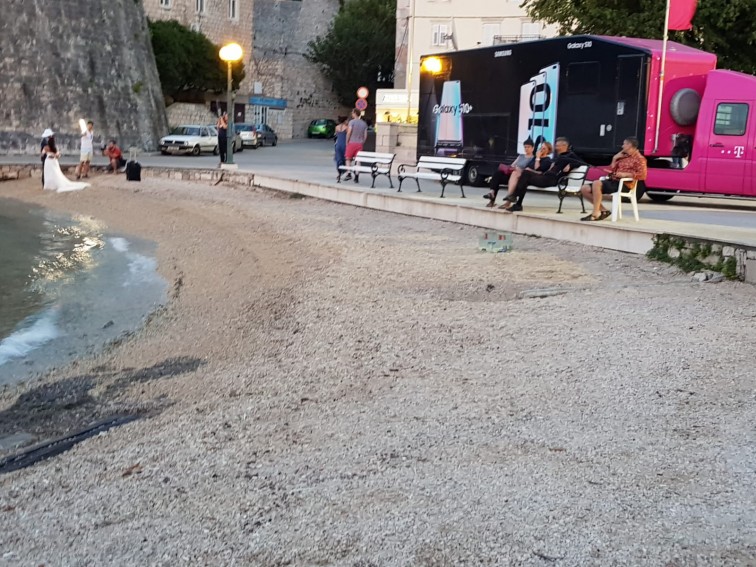
Imposition of proprietorship over natural resources which were accessible to all for centuries is a problem that, under the pressure of neoliberal politics, has been encountered ever more frequent lately, as much in Croatia as well globally. Besides oil, minerals, ore and other natural resources whuch have been privatized, corporations took over even water and air, also in Croatia. Operators of telecommunications take up radio frequencies, and corporations take long-term concessions of potable water wells. Recognition of the UN of the access to clean water as human right was made in 2010 and it speaks of the urgency and importance of questioning natural resources for basic biological survival of human race and animals, their protection from pollution and contamination, as well as protecting democratic ways of the their usage as common good.
“Performance hopes for a miracle”, significantly says Labrović and pinpoints the open end of the interpretation of his work. Communication with the citizens during the performance is a part of the work that opens up further possibilities of creation and interpretation of the work by participants. A moment of expectations builds up on the Beckett's theater of absurd as in Waiting for Godot. Author suggests even further possibilities of reading the work: "To me it all has to do with the fish of Jesus with which those in hunger were fed, but also with the neoliberal end of history, and served reality that is only here for consumption, but not for creation, as well as with ecology and final destruction of those six fish with which Jesus fed the hungry ones – perhaps there will be no hunger, but there will be no fish either, and no miracles, as it seems now...here are time, absurd, "aimless" effort, however, hope for miracle, persistent insisting on searching for a miracle... (3) I can only hope that at least the curator and audience hope for a miracle, too."
1 Siniša Labrović, email correspondence with Darko Fritz, April 2019.
2 Archeological remnants on the island of Korčula (the most famous in Vela Spilja) next to Vela Luka, prove that people inhabited the island even when it was in its formative period.
3 Siniša Labrović, email correspondence with Darko Fritz, April 2019.
About author
Siniša Labrović was born in Sinj, Croatia, in 1965. He has exhibited all over Croatia and abroad. In 2005 he attracted the attention of world media (such as Reuters, BBC, Ansa, New York Post, Guardian, Times, NBC, ABC) with his work „Flock.org“ in which sheep were the contestants in a reality show. In the 2007 for the video „Family Diary/News“ he won the purchase prize at the first T-HT and Museum of Contemporary Art competition in Zagreb. This work is in the permanent display of the MCA, while the video documentation of the action „Bandaging the Wounded“ (2000) is in the permanent display of the Fine Arts Gallery in Split. Several works are in the collection of Museum of Modern Art Dubrovnik. He is represented by the Galerie Michaela Stock from Vienna.
In 2009 at the 11th Istanbul Biennial he presented the work „Lisansustu Egitim/Postagraduate Education“.
In 2012 he represented Croatia on 13th Venice Architecture Biennale, titled Common Ground, together with Pula Group, Hrvoslava Brkušić, Igor Bezinović and Boris Cvjetanović.
Siniša Labrović is a freelance artist who lives in Berlin.