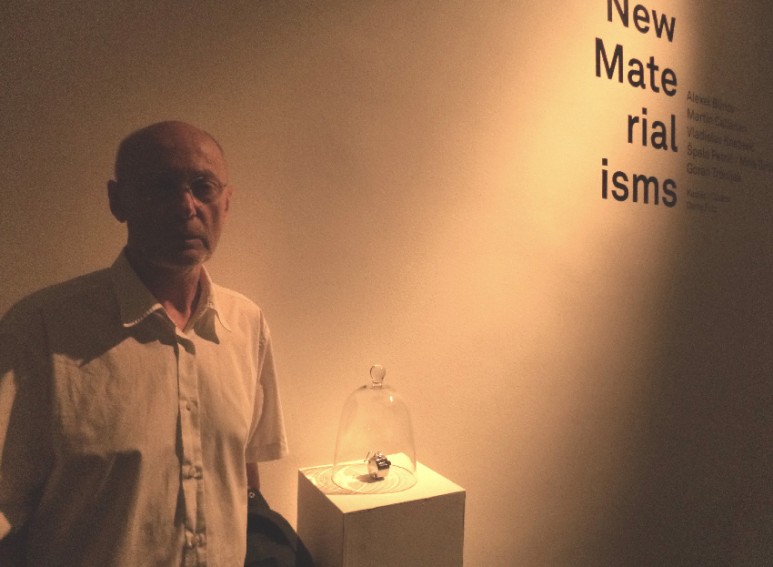
New Materialisms (Station 3.2)
free entrance for seeing this artwork
Among many objects exhibited within the permanent exhibition in Korčula town museum, there are also two works by conceptual artist Goran Trbuljak at the display.
In the untitled work, which has been in the museum since the early July, there is a hand counter which the author counts the visitors with, or more precisely, the visitors who have been coming to his solo-exhibitions openings since the early 1970s until now. Those who have come more than once are counted only once.
The second work is also without a title, and it is exhibited starting from July 25, 2016. Identical hand counter, but with another figure, one which shows the number of the people who came to his solo shows in 2016 (there have been three shows so far).
With these works Trbuljak, via for him typical institutional critique, takes part in the questioning of the large quantification of the matters and phenomena in contemporary society from the first person position, which also reflects on the interpretations of the notion of new materialism seen through the optics of different fields that use the same term, but very often with different meanings.
New Materialisms project reflects historically divergent art practices and discursive fields of concrete and conceptual art, as defined in the 1960s. Project tackles understanding of those art practices through the discourse of post-media contemporary approaches to art as well as via post-digital condition of our every day life, whereby digitality is interwoven with each aspect of our social being. New Materialisms strives to formulate a dialogue among important authors of concrete and conceptual art and contemporary practitioners who work within the post-media context, while assuming the design of aesthetical experience as vital mechanism which has its agency in the process of creating the physical world.
Part of the exhibition Materialisms (station 3). New Materialisms series is a long-term program of exhibitions and lectures that has been developed in a collaborative process between grey) (area – space for contemporary and media art from Korčula and HICA (Highlands Institute for Contemporary Art) from Scotland since 2015.
About author
Goran Trbuljak has been active since the late 1960s, in the context of conceptual art and the so-called New Art Practice. While searching from the very beginning for alternative means of production and representation of the artwork, Trbuljak has redefined the status of artistic context, asking radical questions about the autonomy of the system of museums and galleries and about the mechanism by which something is accepted as art. He tested the accidental as the key moment of creating work mechanism, organizing exhibitions in streets and hallways. For the artist a simple gesture could function as a critique of the artistic and social system. In his spontaneous action in 1969, Trbuljak, ‚“from time to time displays his finger, without the management‚‘s knowledge” through a hole in the door of the Modern Gallery in Zagreb. In 1971, in the gallery of the Student Cultural Centre in Zagreb, Trbuljak exposed only a poster on which was written, I do not want to show anything new and original. In the same spirit, he opted for the most democratic way of finding out whether or not he was an artist, organizing a Referendum in 1972 and asking passers-by to decide. In the questionnaires he distributed in the “Western” shopping malls and art institutions, a few years later, the artist asked whether they would expose his works. In this series of works, entitled Anonymous artist / Goran Trbuljak (1972-1974), he confirms his interest in the issues of authorship and anonymity, confronting the institutional critique, and pushing further his research into how the system of museums and galleries functions, accentuating the market, economic and political context. Still, there are typical traces of humor and self-irony in Trbuljak’s oeuvre. (From “The Promises of the Past”, Centre Pompidou, Paris, 2010)