MA Moments
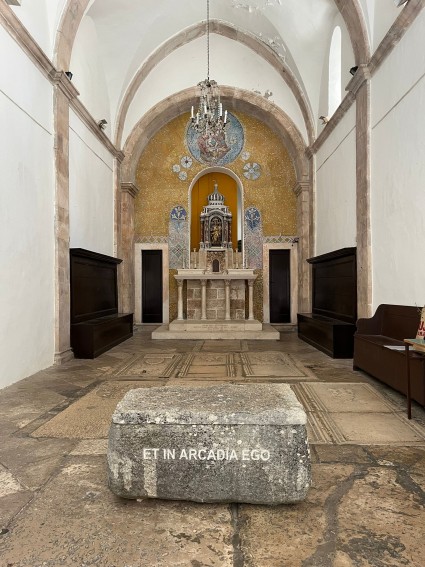
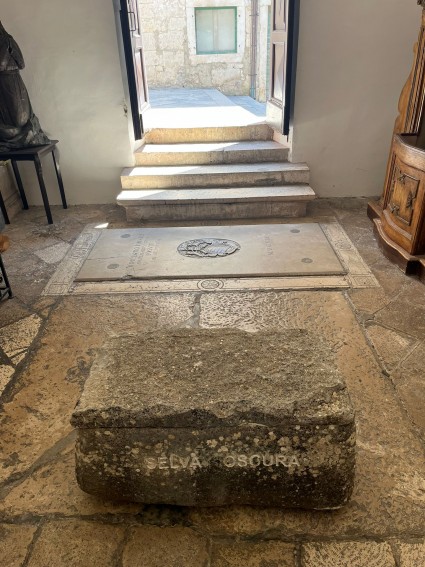
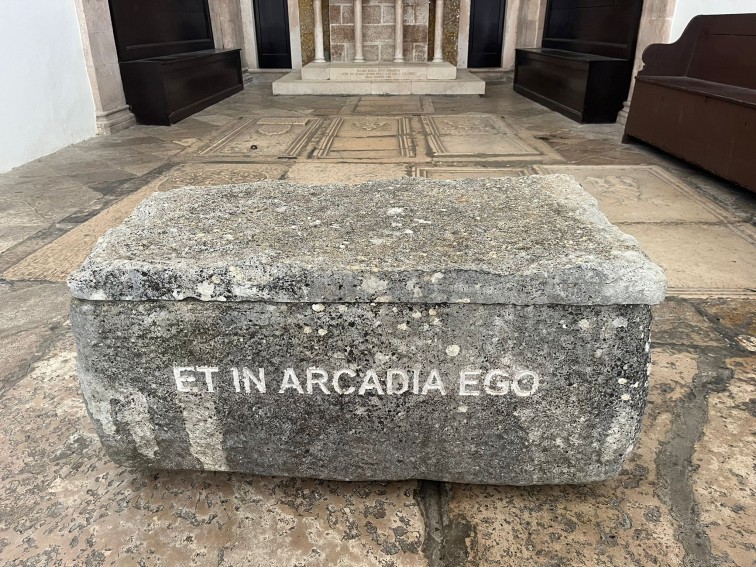
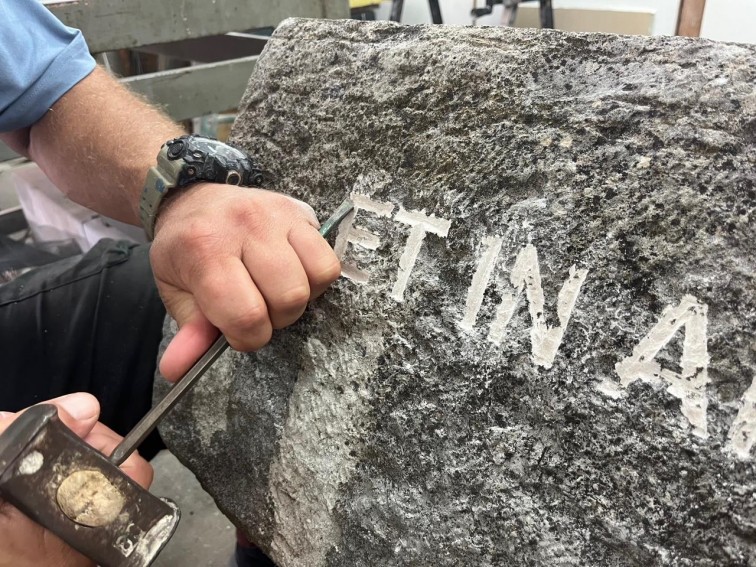
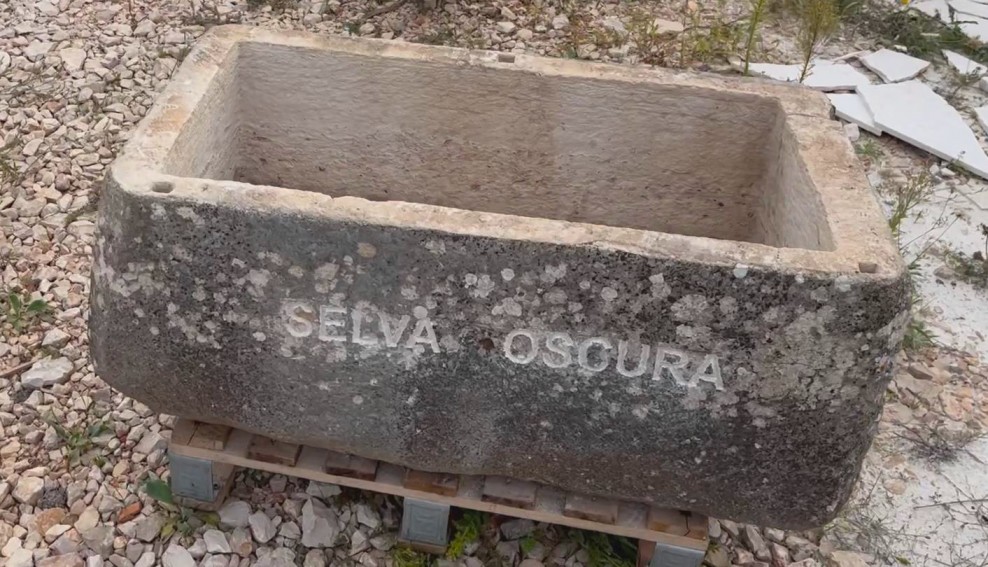
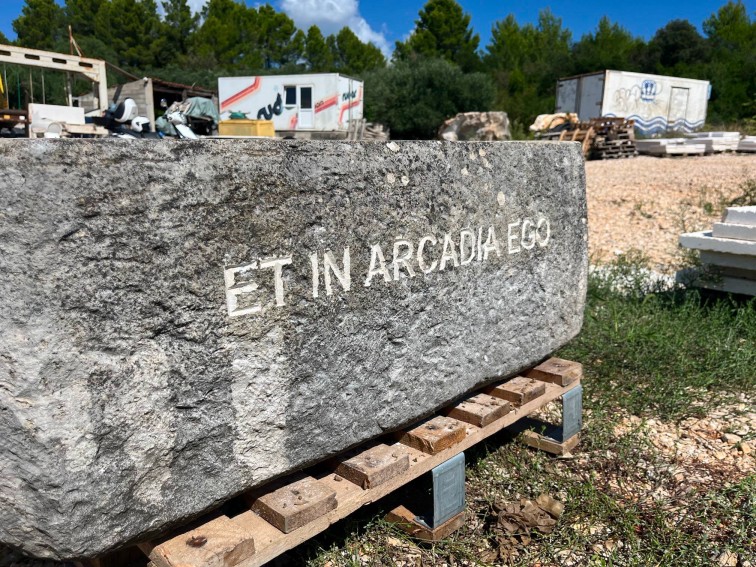
The artwork MA Moments is shaped like a stone sarcophagus, made from an 80-year-old olive oil container. On this stone sculpture, Simon Beer had two inscriptions engraved by hand: the Latin text ET IN ARCADIA EGO (Even in Arcadia, I am present) facing the entrance and the Italian text SELVA OSCURA (dark forest) on the opposite side.
The work addresses two fundamental structural problems on the island of Korčula, which are exemplary for the whole of Dalmatia. On the one hand, there is the ever-increasing tourism industry and, on the other, the associated loss of identity among the local population. Local traditions strengthen cohesion and identity, but with the influx of visitors, these traditions are often reduced to folklore and become meaningless.
The oil container readymade (kamenica) symbolizes the tradition that is slowly disappearing. Today, the stone containers are used exclusively for decorative purposes, such as flower pots. The inscription ET IN ARCADIA EGO refers to the decline of traditional culture, and SELVA OSCURA (from Dante‘s Divine Comedy) represents the loss of one‘s own identity. In between is nothing, the empty oil container refers to the MA from Japanese aesthetics theory. MA is an artistic interpretation of an empty space in Japanese culture, often holding as much importance as the rest of an artwork and focusing the viewer on the intention of negative space in an art piece. The concept of space as a positive entity is opposed to the absence of such a principle in a correlated “Japanese” notion of space.
This emptiness is also reflected in the tourist flows, which are mostly washed up on the island by cruise ships and chase after the next destination after a stay of a few hours. This leaves only time for the selfie, which confirms that the person was actually there. In the times of the Grand Tour, from Michel de Montaigne‘s Spa Excursion (1580-1581), to Johann Wolfgang Goethe‘s Italian years in Italy (1786-1788), travel was an exclusive and usually once-in-a-lifetime experience, and his beloved motto ET IN ARCADIA EGO was a symbol of transience and appreciation for experiences and sights. For Dante, entering the dark forest was associated with having lost his way. And it was only thanks to his benevolent guide Virgil that he found his way back to the path of virtue via hell and finally to paradise. Today “mass tourist” is far removed from such sensitivity and merely consumes the Arcadian realms and the traditions lost within them in a superficial manner. Goethe‘s legendary expression, “Even in Arcadia, I am present.,” could only be expressed because he saw what cannot be seen.
Simon Beer: MA Moments. Korčula 2026/27.
Ulrich Schneider
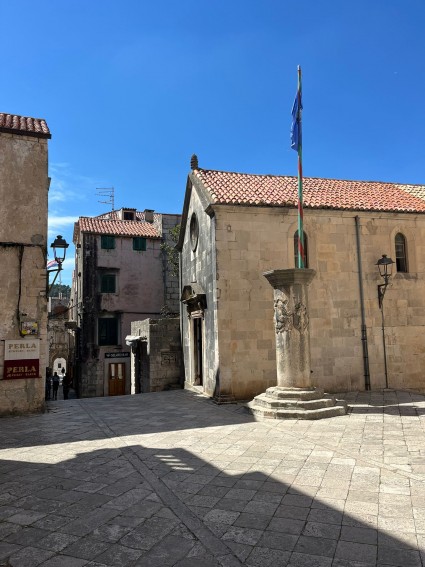
Visitors strolling through the picturesque old town of Korčula who have passed the magnificent façade of the Gothic-Renaissance St. Mark’s Cathedral on the east side of St. Mark’s Square would likely overlook a small church on its south side, were it not for an elegant, coat-of-arms-adorned column stump on an octagonal stepped podium on its northern flank, crowned by an octagonal capital, into the back of which a vertical slot has been cut to hold a flagpole. There, high above the church roof, flutters the flag of Korčula. When the column was erected in MDXV (1515), the Crkva Gospojina, the church dedicated to the Immaculate Conception of Mary, had already stood for 37 years.
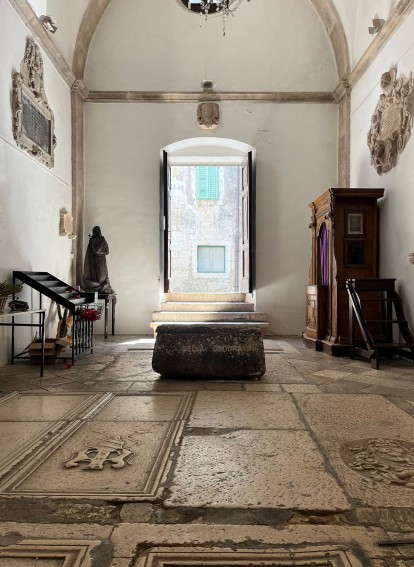
The simple Renaissance building, dating from the last quarter of the 15th century, was consecrated in 1483 by Bishop Malumbra and entrusted as a burial place to the closely related, influential families of the Ismaelis and Gabrielis. Their palaces stand nearby: that of the Gabrielis, now a municipal museum, on the southwest side of St. Mark’s Square, and that of the Ismaelis, now divided into vacation apartments, almost immediately adjacent on the west-bound Ismaellis Alley. Upon entering the Church of St. Mary through the portal—which is always open during the day and features a stylistically confident stepped gable—at the narrow passageway leading to the alley mentioned in the city charter of 1241, three steps descend into the two-bay-long, cross-vaulted nave, on whose floor several tombstones of the Ismaelis have been preserved. They are recognizable by the coat of arms of the originally Venetian family: three light-colored beams slanting to the right beneath the tower finial held by lions, as also adorns the Palazzo. To the north, the church interior concludes with a Baroque altar and a sculpture of the Virgin Mary, surrounded by a mosaic by the Dutch mosaic artist Louis Schrikkel (1964/67).
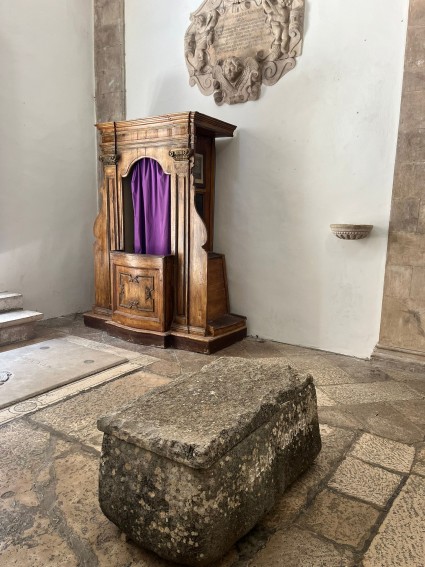
For one year, a foreign object now stands in this church interior: a sort of chest made of roughly hewn local limestone, just over a meter wide and at a comfortable sitting height. Weighing a quarter of a ton, it holds a volume of 250 liters and is covered by a stone slab. In clear Antiqua capital letters, the familiar words ET IN ARCADIA EGO greet visitors on the front broadside, who are later dismissed with the rather enigmatic greeting SELVA OSCURA, carved on the back. This scriptural intervention transforms the seemingly banal foreign object into an artifact, into a work of art.
This object was found, modified, and installed in its current location by the Swiss conceptual artist Simon Beer (* 1964). After training as a machine mechanic in Zurich and attending the local cantonal high school, he went on to study art and communication at the Zurich F+F School for Experimental Design. He subsequently succeeded as an independent entrepreneur in the fast-paced field of the communications industry. At the same time, since 1989 he has participated in over ninety solo and group exhibitions in Switzerland, Germany, Austria, France, England, Japan, Italy, and Croatia. Until 2012 he lived and worked in Zurich and Fribourg, commuting to Bordeaux until 2022, while remaining based in Switzerland.
Beer discovered the island of Korčula, located between Split and Dubrovnik, during his sailing trips along the Dalmatian coast and decided four years ago to settle there with his life partner Françoise Bousquet. In the small harbor town of Lumbarda on the southern tip, they purchased a plot of land overlooking the sea, where they are engaged in creative, ecological food production and where, among twenty olive trees, his partner and architect is designing their studio house and laboratory. Since then, he has been exploring the landscape and history of the island and its surroundings with his characteristic idiosyncratic curiosity, whether on foot or by SUV, always on the lookout for objets trouvés, which have long been at the center of his artistic practice. The stone chest in question is one of them.
The island of Korčula, which owes its Greek name Melaina Korkyra—meaning Black Corfu—to its rich pine and holm oak forests, ranks among the most picturesque islands in the eastern Adriatic, not least because of these forests, which have been tended since the Middle Ages and still cover more than half of its 280 km². Like an anchored navigation mark, a buoy, this small island weathered the wild storms of history, during which it was subject to Greek, Roman, Byzantine, Venetian, French, English, and Austrian rule before falling to Yugoslavia in 1918. Korčula was not spared Italian and German occupation during World War II. Since 1991, Korčula has been part of Croatia and is now a member of the EU and the Eurozone.
It is no wonder that a highly headstrong population developed on the island, one that isolated itself from foreign rule while readily embracing its positive aspects. The town of Korčula, in particular, owes its fortified appearance and magnificent buildings—where the town’s patrician class, insisting on independence, settled—to the Republic of Venice, which ruled there from 1420 to 1797. The same applies to the rural population, which today makes up two-thirds of the approximately 20,000 inhabitants and lives mainly from olive cultivation, viticulture, and tourism. Of course, their traditional independence and distinctiveness are threatened by the tenfold increase in tourists who flock to the island every year during the summer months, some for extended vacations, most only for a short time.
A phenomenon, as in all tourist centers from Venice to Zadar, Split, Dubrovnik, and Corfu, is the crowds from cruise ships that also enter the port of Korčula during the season and depart again after just a few hours. Then the old town regularly fills with a crowd that, after taking a few obligaroty selfies to prove they were there, tends to show little interest in profound historical culture, preferring instead to focus on folklore, such as the aforementioned Marco Polo birthplace. And it is precisely this phenomenon that Simon Beer’s artwork, situated in the Church of Our Lady, aims to highlight.
The stone chest, which some visitors might mistake for a seat, a small sarcophagus, or a covered trough, is originally a household item typical of Croatia—a container for about 250 liters of olive oil, known as a kamenica. In the past, such a container stood in every farmhouse on the island and kept the precious liquid fresh for one to two years. Everyone on the island, both the older and some of the younger generations, knows its significance. Today, since steel tanks require less maintenance, they are often relegated to serving as large flower pots. Beer discovered his well-preserved specimen, which was manufactured around 80 years ago, at the home of the son of a deceased stonemason, from whom he acquired it and set it up on his property for contemplative observation, sensing that there was more to this objet trouvé than just obsolete farm equipment. Indeed, he may have been drawn to its resemblance to a squat ancient sarcophagus.
In the history of art, the reuse of found objects is a common occurrence. Precious porphyry columns, sawn into slabs, became the focal points of Roman Cosmatesque floors in the 12th and 13th centuries, and the imperial sarcophagus of Frederick II (1194–1250) in Palermo Cathedral was also assembled from massive ancient porphyry columns that had been sawn into pieces. During the Baroque period, precious drinking vessels were crafted from exotic found objects, such as nautilus shells, ostrich eggs, or coconuts. Abbot Suger of Saint Denis (1081–1151), one of the most ingenious church leaders of the Middle Ages, describes in great detail how, around 1140, he had his goldsmiths transform a small porphyry amphora—which he had found in a cabinet at the royal abbey near Paris—into an eagle-shaped vase for holy oils, now in the Louvre. It took nearly 800 years before Pablo Picasso, in a similarly brilliant flash of inspiration in 1942, assembled bicycle handlebars and a saddle from a scrapyard into his emblematic bull’s head.
For Beer, the two inscriptions ET IN ARCADIA EGO and SELVA OSCURA on the outer walls of the kamenica, the hermetic enclosure of its interior, and its emblematic positioning at a tourist hub in the old town of Korčula are sufficient to create a work of art. Arcadia is a region in the Greek Peloponnese, an ideal bucolic pastoral land since antiquity, which the Roman poet Virgil (70–19 BC) already sang of in his pastoral poems, the Bucolics, and praised as a dreamland, indeed an earthly paradise under the deity Pan. Johann Wolfgang Goethe (1749–1832) used the reflective exclamation “Even in Arcadia, I am present” as a motto in both volumes of his autobiographical account of his 1786–1788 journey to Italy, published in 1816 and 1817. For him, this statement was likely a sign of reminiscence, thirty years later, of the most beautiful time of his life. Although the exclamation is missing from the Final Complete Edition (AlH) of 1827–1830, with the bestseller of travel accounts from Goethe’s late Grand Tour, the phrase immediately became part of the cultural heritage of the burgeoning educated middle class in the Biedermeier era.
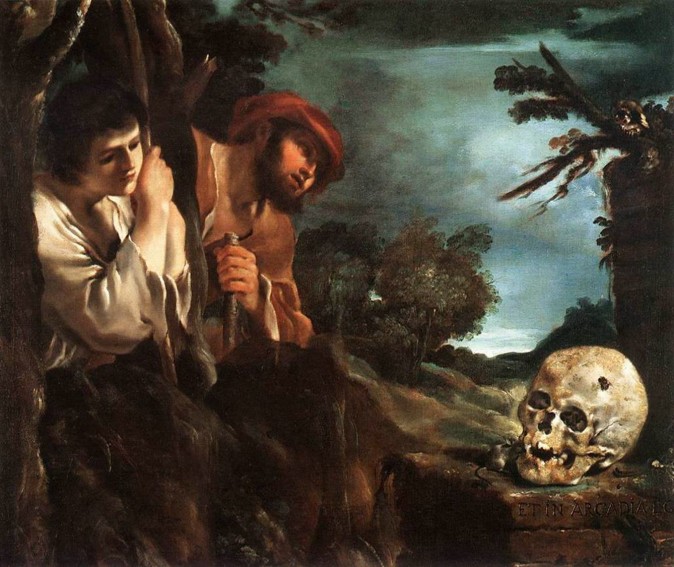
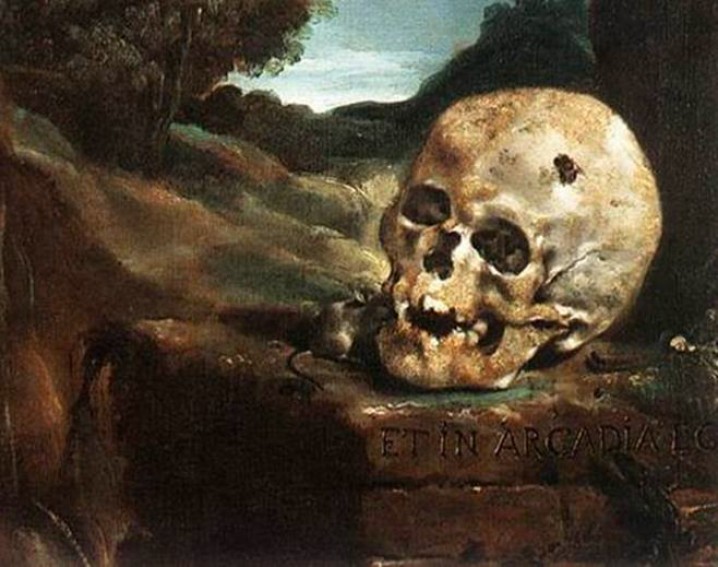
In the commentary section of the Italian Journey in Volume 15 of the 1992 Munich Goethe Edition, the ambivalence of the phrase ET IN ARCADIA EGO is explored in relation to Goethe’s wistful recollection and Giovanni Francesco Barbieri’s (known as Il Guercino, 1591–1666) painting of the same title from 1618/21 (Rome, Galleria Nazionale) as a memento mori is discussed with great thoroughness. Guercino, who was likely the first painter to address the theme of Arcadia, depicts two shepherds in just such a bucolic landscape, startled by a squat stone coffin—not unlike Beers’s “Kamenica”—on which rests a skull with a brutal blow wound , and at which a mouse is still gnawing. The inscription ET IN ARCADIA EGO, clearly legible on the coffin lid, indicates that death is present even in this dreamland. While the shepherds in Guercino’s painting are particularly struck by the skull, the inscription is directed more toward the viewer of the picture.
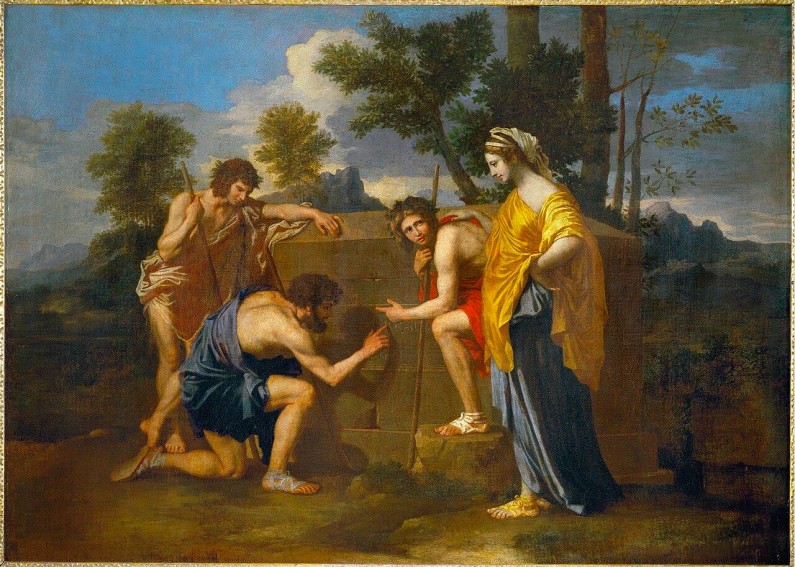
Nicolas Poussin (1594–1664), who was acquainted with Guercino and his circle during his time in Rome, depicted shepherds and a shepherdess in an Arcadian landscape encountering a sarcophagus—here elaborately rendered—bearing a skull and inscription in an earlier painting of the same subject from 1624/25 (Chatsworth, Duke of Devonshire). In a second version from 1635–38 (Paris, Louvre), a squat sarcophagus made of stone blocks stands in the bucolic landscape. Three shepherds, clearly literate, are intently puzzling over the inscription on the façade, while a matronly woman, in her calm wisdom, intimately points to the omnipresence of death even in earthly paradise.
Thus, while the inscription on one side of the kamenica represents the bucolic half of the island of Korčula—not without alluding to the transience of this earthly paradise—the inscription SELVA OSCURA refers to Black Corfu with its forest cover, unique among the Dalmatian islands. This term originates from Dante Alighieri’s (1256–1321) *Commedia* (1307–1321), now known as the *Divine Comedy* and considered a masterpiece of world literature, in which the Tuscan poet sings of his journey through Hell and Purgatory to Paradise. Right in the first canto of *Inferno*, he describes his wandering in the *selva oscura*:
|
When half way through the journey of our life I found that I was in a gloomy wood, because the path which led aright was lost. |
Nel mezzo del cammin di nostra vita |
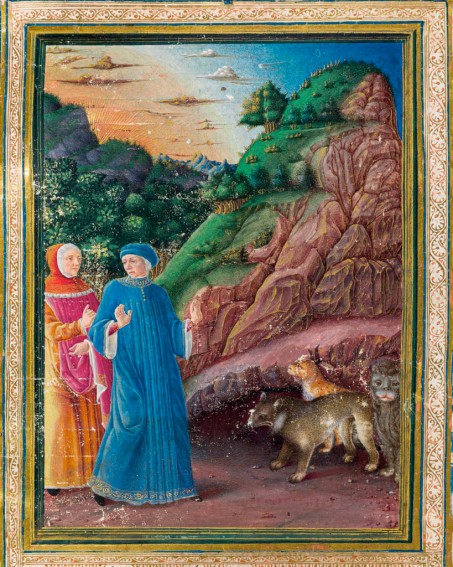
Three predatory beasts, each laden with symbolic attributes—a she-wolf, a lion, and a leopard—prevent him from leaving. The three animals from Jeremiah 5:6 symbolize the three kinds of sins that lead the unrepentant soul into one of the three great chambers of Hell. These are intemperance (the she-wolf), violence and bestiality (the lion), and deceit and malice (the leopard). In his distress, a figure appears to Dante who identifies himself as the poet Virgil, whom we already know from Arcadia:
|
“Art thou that Virgil, then, that fountain-head which poureth forth so broad a stream of speech?” I answered him with shame upon my brow. |
«Or se' tu quel Virgilio e quella fonte |
Virgil is now his protective and guiding companion all the way to Purgatory.
Over the centuries, charming illustrations have accompanied the manuscripts of *The Divine Comedy*, which the artist Beer is able to reference. For example, in the *Vita Imperatorum* of 1413 (Paris, BNF, inv. 2617), the Lombard master depicts the scene in a stylized nocturnal rocky landscape. The rather youthful Dante, dressed in a blue robe and red beret, stands anxiously on the path, beset by the three very naturalistically rendered beasts. The aged Virgil, clad in a red cloak, emerges visionarily from a crevice in the rock and turns toward Dante. In a later Central Italian manuscript, the Commedia di Federico da Montefeltro (1422–1482) from 1478/82 (Biblioteca Apostolica Vaticana, Ms. Urb. Lat. 365, c. 1 r.), Dante, dressed entirely in blue, and Virgil, in red, violet, and gold, approach the waiting predators. While the landscape—the rock formation on the right and the selva oscura on the left—is rendered in an idealized, realistic style, the animals appear somewhat clumsy: the she-wolf resembles a badger, the she-leopard a lynx, and the lion a tomcat. Remarkably, however, the landscape resembles that of Simon Beer’s Melaina Korkyra.
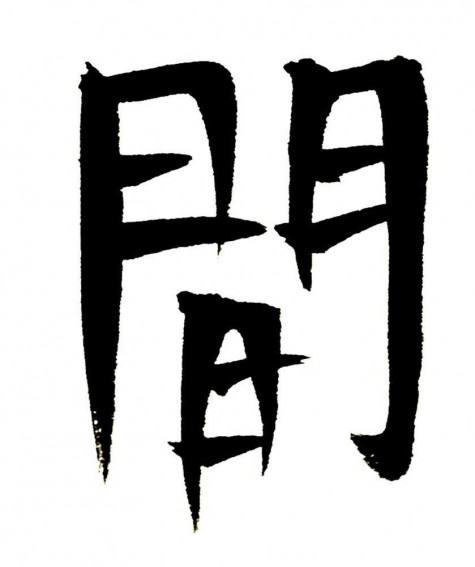
Thus, the artifact—a covered kamenica with two inscriptions—may stand as a symbol of the artist’s second phase of life on Korčula. But what does the enigmatic title of the work mean: MA Moments? Simon Beer, who also studied Japanese philosophy and epistemology during his academic career, draws a surprising conclusion here: 間 MA is a key component of Buddhist and Shinto thought. The highly evocative Chinese character is composed of the outer boundaries, 門 for door, and the central kanji, 日 for sun, and thus signifies Ma (negative space). Ma is a Japanese word that can be roughly translated as “gap,” “space,” “pause,” or “the space between two elements.” The concept of space is experienced step by step through intervals of spatial designations. In Japanese, “ma” means space and signifies an interval. It can best be described as a sense of place—not in the sense of a closed three-dimensional unit, but as a simultaneous awareness of form and non-form that arises from an intensification of perception.
Thus, the MA Moments consist of the two marginal elements of finite Arcadian enjoyment and the overcoming of the selva oscura. True insight, however, is to be sought in the hermetically sealed interstice of the kamenica, though it remains open whether it can be found. This is the task Simon Beer sets for visitors to the Church of Our Lady in the centre of Korčula with his installation. People who are accustomed to having every action taken care of for them on their holiday trips would have the opportunity here for meditative reflection.
Previous journeys had a destination, but also a path. Simon Beer has explored this theme extensively in his work. For instance, in 2012 with the project Adventus in Meymac, where he made a pilgrimage from Zurich to the Abbey of Saint-André in Corrèze, France, over the course of 25 existentially taxing days. In 2019, with the project Quelqu’un qui s’occupe de moi, he explored the fate of stray ocean buoys from Arcachon. Or much earlier, in 1996, when he followed the absurd world tour of the cult doll Barbie with the project Dear Diary, everything has happened so fast and furiously that I can hardly believe I’m really on my way around the world. Perhaps with the project MA Moments, he’ll manage to reach some members of the audience for whom a half-hour wait at the airport already seems like an imposition.
About author
Simon Beer (b. 1964, Switzerland) is a conceptual artist who studied art and communication at the F+F School for Experimental Design in Zurich. Since 1990, he has exhibited internationally in over 90 solo and group exhibitions, including at Museum Abteiberg (Mönchengladbach), Kunsthalle Winterthur, and Espace d’Art Contemporain (Paris), as well as major events such as the Echigo-Tsumari and Setouchi Triennales in Japan. He has received grants from the City and Canton of Zurich, the Steo Foundation, and the UBS Culture Foundation.
Working across sculpture and installation, Beer recontextualizes objets trouvés from consumer culture. His practice explores themes of seduction, transience, and the construction of idealized “paradises,” engaging critically with the aesthetics of advertising and the tension between illusion and disillusionment.
www.beeronline.ch
Ulrich Schneider, Prof. Ph.D., is an art historian who has worked for more than 30 years as a senior curator and director of several German museums. He has lived and worked for many years in Italy and Japan. In recognition of his international collaboration, he was awarded the honors Cavaliere Ufficiale dell’Ordine al Merito della Repubblica Italiana and Chevalier de l’Ordre des Arts et des Lettres de la République Française. He teaches Art History at the Johann Wolfgang Goethe University in Frankfurt am Main.